Monday, November 2, 2009

Raison d’etre: The Reason and Reality of Mind and Matter


The world is known by the mind through logic, senses and experiences. For each individual, the world is a picture painted distinctively different than that of every other individual in existence. To say that reality however, is an illusion is a premature thought. Instead, it is the way reality is perceived that differs from every known conscious mind. In saying so, reality for every individual should therefore be unique and a stand alone perception of the physical world.

“Reality is merely an illusion, albeit a very persistent one.”

~ Albert Einstein

Even if we step into another dream every time we awake from sleep, an independent reality persist as a constant and unchanging truth. Through imagination, we are able to conceive things or events that defy the laws of nature and physics. But even in doing so, all products of our imagination are but a combination of matter and ideas taken from a persistent and independent reality. Take for example, the ancient imaginary creatures of mythology. The minotaur is but the combination of a bull and a man while a mermaid, the combination of a fish and a woman.

Like a pendulum swinging back and forth and never stopping in the middle, so does our mind swing from one extreme to the other. We commonly think that certain things like ethics and morals are absolute principles when history have often proven that the accepted norm of moral and ethics change in each age. Consequently some people think that absolute relativism of morality is a possibility even though it is an absolute principle. Obviously, this is an impossibility because one cannot state that all absolute principles are ‘absolutely’ wrong. Indeed, this would be a great folly committed by an irrational mind.

“Man is born free, and everywhere he is in chains.”

~ Rousseau

For anything to exist in its entirety, it must be for the observing mind both a cause and effect or an action and reaction. The egg for example, is the cause of the full grown chicken as certain as every egg is the effect of a full grown chicken. All things ranging from the mind and matter must therefore be understood not as a stand alone truth but as a sum of its relation with all other things known to the mind. Thus, it is impossible to understand something that is absolutely independent of everything that exist in reality.

The relationship between the society and the individual also falls into the boundaries of cause and effect. Every individual is the product of the society and is chained to a reality set by its immediate environment. From the other end, society would not exist without the individuals that give meaning to its existence. When relations are concerned, a book is only a book when it is treated and perceived like a book. Should a book fail to be read by a human being who understands the language used in its construction, the book degrades into a mere object or matter and thus not a book anymore. It is the human being, the creator of languages and its written forms that the book must exist for because without humans, the book loses its meaning of existence.

“All things appear and disappear because of the concurrence of causes and conditions. Nothing ever exists entirely alone. Everything is in relation to everything else.”

~ Buddha

Reality is the product of the interactions and relations between the living and non-living, the conscious mind and the environment, the individual’s identity with society. A person’s identity and the justification of its existence is not independent from society. No man is an island or a hermit that is totally free from his environment. Having said so, the conscious mind is only an incomplete factor that constitutes an individual’s identity. Throwing aside the consciousness of thought, memory and emotions, a person’s identity is also defined by the unconscious mind to which the individual has little or no control of.

What we think of ourselves is only a small fraction of the true reality of our identity. The understanding of ones ego is limited by the very same limitations that set the boundaries between absolute knowledge and that capable of human understanding. One must understand that although the philosopher Descartes advocated that one must look from inwards to outwards to understand himself and the world, it is also equally important to understand the relations of the external to the internal. In simple terms, we must know both the role we play in society and the role society plays in shaping our identity.

“I think, therefore I am.”

~ Descartes

I think, therefore I am is only ones perspective concerning himself and his external environment. According to this perspective, what I think concerning the role I play in the greater picture of society takes precedence over external factors. But since every other individual would also have a different perspective on the role I am playing in the world, both my perspective of myself and the perception of others about me would seldom agree with one another. The combination of these two parts of one would show that an individual’s identity consists of the summation of all causes and effects of his existence to both the living and the non-living. Thus, I think, therefore I am must be coupled together with you think, therefore I am.

The other element that is essential that constitutes ones identity is time. For the better part of this essay, time is left out and identity is judge as a static object both rigid and without motion. In truth, this is impossible because time is an unstoppable flow from the past to future limiting all men by its current. A man is not only defined by what he has done but also by what he will do. Before World War II, Hitler was regarded even by some British as the savior of Germany and the hero that would defend Europe from Communism. After World War II, Hitler would always be remembered as the cruelest mass murderer the world has ever seen!

“Without knowing life, how can one know death?”

~ Confucius

The very sound of our heartbeat shows that we are the bounded by the flow of time. Like a clockwork toy edging closer to its end, the steady rhythm of our heart proves that we are both alive and moving closer to our death. As this process inevitably happens, our identity transcends from one form to another influencing more and more events in the physical world. An individual’s identity in contrast to the conventional wisdom, is not just a static object but a dynamic growth to which the sum of all parts until our death and beyond is its true form.

As a person’s identity changes, so does his reason for being. This is probably the reason why ones perceived purpose in life is often changing as one ages. In fact, it would be exceedingly peculiar if an individual’s views and goals remain exactly the same after an interval of prolong development either in mind or in body. As certain as a person’s physical stature changes as he age, his state of mind is also compelled to change in relation to his environment and condition. Therefore, it is motion with its velocity and magnitude rather that a stationary unchanging element that is the fundamental constant of our identity.

“We know the mind, only as we know matter.”

~ David Hume

“How can we explain mind as matter, when we know matter only through the mind?”

~ Schopenhauer

It is extremely hard to determine which is the cause and which is the effect when it comes to the mind and matter. In an ever changing reality of time and space, it is the mind that understands matter although the mind resides within matter itself. While it is common to say mind over matter, one must remember that there is an independent reality separate from the mind’s ability to perceive it. The laws of gravity for example, holds true even before its formal discovery by Isaac Newton. In line with this, the truth that the Earth is not the center of the universe also holds true before its revelation by Copernicus.

The presence of an independent reality that we will not understand with absolute certainty is perhaps the clearest prove that our identity and mind is real. Consequently, this means that an absolute truth that is independent of the senses and experience is also possible should the boundaries to which this ‘truth’ revolves in is set with proper care and consideration. The limitations of these absolute truths, for example time, numbers and change, is limited only by the boundaries of a relative reality. This enables the possibility of an absolute truth to reside within a relative world.

While absolute knowledge is impossible for human beings, each and everyone of us can still learn enough to understand his purpose and reason for being. One must however, acknowledge that the answer to this can only be true relative to a certain environment within a limited time frame. It is an imperative that one must embark on a neverending journey to discover the very answer to the meaning of ones own existence.

~

_____________________________________________________________

The Limitations and Possibilities of Man

The Inconclusive Synthesis

This is not the conclusion or an epilogue. It is not the last chapter of a tale written for the sake of justifying ideas, ideologies, and beliefs. I have no drama left in me and I fear that subtlety has at last failed me and bluntness and blunders are all that is left. Unlike the first six chapters of the Meditations, I start this one with a diagram of my own creation instead of some historical painting.

The art of men long dead would be by far a more fitting abstract art than anything that I can produce in my life. However, the diagram above is a simple representation of my will and idea behind the Meditations. No aspect of humanity is a stand alone complex that is self-reinforcing, self-generating, and self-inducing. Everything in life as I have observed are inter-connected, inter-related, and inter-locked. Indeed, the flapping wings of a butterfly can cause a tornado somewhere else or potentially stop one.

In the last of the seven Meditations, I hope to succeed more than I have failed to piece together the broken pieces of One.

Man and Woman Contemplating the Moon by Caspar David Friedrich

The Bias Theory and The Bias Society

Take a coin and toss it into the air fifty times and you would find that equilibrium never exist like the way we think it exist in reality. If you somehow manage by stroke of luck to get 25 heads and 25 tails, toss that coin another hundred times. Things are never perfectly equal! The world and its happenings are like a pendulum swinging from right to left and never stopping perfectly in the center!

If things were in perfect equilibrium, the government and the opposition parties of any country would get the same amount of votes and the possibility of elections would disappear. Randomness is a lie. Things are perceived to happen randomly because one cannot comprehend all things under heaven or judge with precision the consequences of ones own actions. In retrospect, things seem to be fated and can happen in no other seemingly probable way.

Einstein was right when he said the God does not play dice.

The hypothetical ‘if’ is for the future and not the past. The past is set in stone and would never change for anyone or anything, save the will of the Creator and the time machine of H.G. Wells. The bias theory is real and it applies to everything in the world worth observing. Why is time a constant movement from present to future? Why is it that twins have different characters when they come from the same mother (and come to the world almost at the same time)? Why do we choose one apple over the other when both looks similar in size and color?

The truth is that the world is never in constant equilibrium but in constant movement. Take a look at the waters of rivers around the world. Watch how the rivers flow to the sea, the water evaporating, the vapors accumulating and at last coming down as rain just to repeat the cycle all over again. Nothing in the world is really stagnant! Everything seems to move as though the Creator’s will is willing it (this is what I believe)! If this is so, does that mean the bias theory applies to all things?

Swarm Intelligence and Societal Intelligence

If ants had intelligence and could comprehend the works of human beings, they would comment on how similar human beings and ants are. While we ‘modern’ (this is such a misnomer) human beings think that our skyscrapers, overhead bridges and construction machinery are the best ever created in history, be surprised because ants have been building highways, underground nests, and staging epic raids for the last 140 million years.

While we call the ability of ants to solve problems as swarm intelligence, we often forget that human society works by a similar concept of societal intelligence. Like ants, I dare say that no human being could grasp the whole picture (absolute knowledge of everything) yet every individual of the society contributes to humanity’s success as a species.

Take a trip back through time and look at the French Revolution in 1789. Instead of eating cake (Marie Antoinette believed ‘cake’ was available for the peasant class) and starving to death, the French peasants rebelled and executed their King, Louis XVI. Similar to the revolution in France, the 1917 Revolution in Russia also demonstrated a societal intelligence in changing the ruling political system before it was too late (though Communist Russia did not do a better job).

A more recent example is seen in Seattle when anti-globalization activists used mobile communication devices (ironically, mobile phones were one of the devices that spurred globalization) to spread news quickly about the movement of law enforcers. This turned what an otherwise disorganized and unruly crowd into a ’smart mob’ that was able to disperse and re-group like a school of fish. Similar to this, both Google and Wikipedia taps into swarm intelligence to produce outstanding results!

Individual Intelligence, Rational Expectations and Rational Behavior

Aristotle was right when he said that human beings are rational animals. The only problem is that the bias theory applies similarly to an individual as to a society. What is rationality? The answer differs from one individual to another. There is no absolute answer for rational expectations or rational behavior.

To an Eskimo, leaving his parents to die when they are old seems rational. To most of us, this seems absurd (in thinking so, we prove the bias theory). A human being can never accept every idea, behavior, and culture under the sun. An absolute hypocrite (absolutely tolerant of everything) is an absolute impossibility (though we may pretend to be tolerant of all things). Whether we like it of not, we are subject to our own form of personal bias (I like the color black).

In saying so, almost everyone in the world acts out of self-interest (this is distinctively different from selfishness). Even if my parents love me unconditionally, it is in their self-interest to do so (of which I am very very VERY grateful). This is because my parents feel happy to love me as they do (this should apply universally to all parents). Human beings choose to do things that give them the most utility or happiness and thus, they act in accordance with their self-interest. To deny this is akin to denying one’s own existence.

Arthur Schopenhauer was right when he claimed that the world was his idea. The external world is indeed known only through sensations and ideas, hence subject to personal bias (which is why he said his idea). Indeed, how can we, mortal humans, explain the mind as matter when we know matter through the mind? Furthermore, Schopenhauer described it better than I when he said that we do not want a thing because we have found reasons for it, we find reasons for it because we want it!

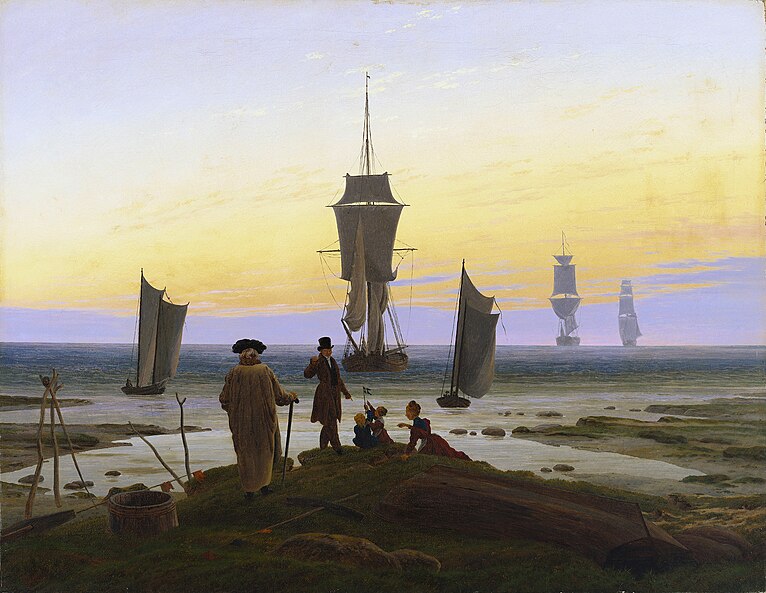
The Stages of Life by Caspar David Friedrich

Why is Choice and Free-will Subject to The Bias Theory

Contrary to popular believe that everything in our lives starts with choice, everything in our lives actually starts out of necessity. Rousseau was only partially correct when he said that man is born free and everywhere he is in chains. If all choices were ours to make, and an absolute free-will is ours to use, human beings would be the Creator! Utterly absurd!

Furthermore, if we can choose all choices, there would not be such thing as ‘choice’ because we can obtain everything. Choice would be non-existent. When Rousseau said that man is born free, he was not entirely right. We cannot choose who our parents are, just as our parents cannot choose who their parents were. The choice to come into this world itself is not ours alone to make, but an accumulation of choices of people long dead.

It is therefore inevitable that humanity’s grasp is forever lower than its reach. We make choices because we can choose but because we must choose! And in choosing one choice over another, we forsake the second best choice (known as opportunity cost in economics). Scarcity is mankind’s immortal enemy. The limitations of resources causes scarcity that forces us to choose what we think is best for ourselves (or others).

In saying so, resources does not only mean land, labor, capital, and entrepreneurship but also time which is the ultimate resource among the rest. Peter Drucker was right when he said that time was completely inelastic. No matter how much you are willing to pay for ‘time,’ you can never really ‘buy’ time. Thus the famous saying that time and tide waits for no man.

Remember however, that as long as we live, we still have a limited degree of choice in certain things in our lives. It is still possible as my friend reminded me to take an umbrella out even though we do not know when it is going to rain. It is possible to achieve something that your heart desires as long as it is achievable and within reach. One should not lose hope even when one knows that he will eventually die. Instead, one lives on in hope that death would come another day.

Perfection is therefore an impossibility unless one defines mortal boundaries within a mortal scope of activity (this is only a ‘perfection’ in human definition). When asked by Alexander the Great of how man can become a God, the Indian philosophers replied that Alexander had to do something that man cannot do. Alexander did not become God and neither can other human beings.

But lo and behold, in this text of pessimistic limits lies an optimistic hope. For surely as an individual is a part of the society and a society is a part of a nation, the nation is a part of the Earth and the Earth a part of the Universe , the Universe is a part of something bigger, greater and beyond human understanding. This is what I believe as the Creator that encompasses all things, omnipotent and omnipresent. Our imperfection is the only prove we need to justify the existence of a Creator. And in the Creator, all the hopes of humanity lies.

The Wanderer Above the Sea of Fog by Caspar David Friedrich

The End of the Beginning

This ends the seventh part of One and represents the final piece in the Meditations. The Meditations represent not an ending but a new beginning and a new journey. The Meditations should therefore not be perceived as Beethoven’s Ninth Symphony but Schubert’s Unfinished Symphony that gains beauty in its imperfection. Although the establishment of a priori in saying that man is imperfect and thus his understanding is imperfect, it is the will of the human heart to continue to climb knowledge’s endless flight of stairs.

Many of the mysteries of mankind and our world are now being unraveled by the accumulation of human understanding of knowledge. Although perfect knowledge and understanding is beyond our reach, if gives the heart of man joy to continue to pursue it! Even as Voltaire has said that we shall leave the world as foolish and as wicked as we found it, we can still strive to be happy and jovial as Voltaire himself was.

Encourage therefore the practicality of Voltarian wit, tolerance, and spirit and put to rest the impracticality and impossibility of Rousseau noble savage!

_

_

The Road Not Taken

Two roads diverged in a yellow wood,
And sorry I could not travel both
And be one traveler, long I stood
And looked down one as far as I could
To where it bent in the undergrowth;

Then took the other, as just as fair,
And having perhaps the better claim,
Because it was grassy and wanted wear;
Though as for that the passing there
Had worn them really about the same,

And both that morning equally lay
In leaves no step had trodden black.
Oh, I kept the first for another day!
Yet knowing how way leads on to way,
I doubted if I should ever come back.

I shall be telling this with a sigh
Somewhere ages and ages hence:
Two roads diverged in a wood, and I—
I took the one less traveled by,
And that has made all the difference.

~ Robert Frost

~

_____________________________________________________________

The Third Interlude – Man and Woman


magritte_13

The False Mirror by Rene Magritte

This is yet another true dialog between me and a girl that of course was published with our joint consent. The world as we know is not perfect and will never be perfect. Yet, should we live our lives in optimism or in pessimism? Is it really better to be in the house of mourning than the house of mirth? Yet one thing is for certain and that we are not perfect and the world we live in is also not perfect.

_

Woman: Men have motives when they flatter a girl. They claim to be sincere but their flattery is but a part of their grand scheme which is to derive pleasure in holding power over a girls heart.

Man: But surely at least one man in three is worthy of the word sincere?

Woman: Maybe, but how do I know which one is sincere and which is not? For men are imperfect and thus liable to the faults of mortality.

If a man treats a woman with all gentleness, a woman is sure to doubt his sincerity. It would not matter if a man treats a woman with no gentleness as long as the man does not have a hidden agenda. Would it not be better for man to treat a woman indifferently but retains all sincerity?

Man: But a woman is unhappy when a man is either too gentle or lacks gentleness. And is not a gentleman held as the perfect virtue in society? So I bid that woman makes her choice. For in my opinion, sometimes a man gains happiness by making a woman happy.

Woman: How is that possible? Do you not see that men are taking advantage of women to satisfy their own desires?

Man: Surely not all men are like the beast of the field as surely as not all birds can fly.

Woman: Oh, but I agree, but disagree for there are more men who are of the beasts than of the bird and this fact alone is enough to question the sincerity of all men.

Man: But even you must agree that man clear of motives exists. And if this is so, a man pure at heart is not like the beast of the field but akin to a rose among the thorns and a candle in the darkness of the night

Woman: I do admit that men pure of motives may exist. But reality is cruel and men like clear water are so hard to find because men in their nature are egoistic creatures. However, most of the time a woman is flattered that a man speaks courteously to her although she knows that it is probably insincere.

Man: It is sad that two perfectly innocent beings are doomed to suffer from imperfection. But at least give your heart some space for hope!

Woman: Indifference is less cruel than a facade of lies, for in showing your true color, one does not rouse false hope. Though world cannot and will not change, maybe the individual can.

Man: Yet against all odds one may still find a piece in a jigsaw puzzle that fits your own shape and by doing so augment you and your weakness with his strength while gaining strength from you to overcome his weakness.

Woman: However, like a box of jigsaw puzzle, there is only one piece in many that can perfectly fit and thus the difficulty in forming a perfect bond between man and w0man.

Man: But life is a war against the greater odds and can sometimes be portrayed as a knight charging into an army of phalanx.

Woman: I suppose the only thing we can do is live as we have no say in when, where, and why we were born.

Man: Live and Hope!

_

SONNET 138

_

When my love swears that she is made of truth,

I do believe her, though I know she lies,

That she might think me some untutored youth,

Unlearned in the world’s false subtleties.

_

Thus vainly thinking that she thinks me young,

Although she knows my days are past the best,

Simply I credit her false-speaking tongue;

On both sides thus is simple truth suppressed.

_

But wherefore says she not she is unjust?

And wherefore say not I that I am old?

O love’s best habit is in seeming trust,

And age in love loves not to have years told.

_

Therefore I lie with her, and she with me,

And in our faults by lies we flattered be.

~ William Shakespeare

~

_____________________________________________________________

Sunday, November 1, 2009

The Limitations of Wealth and Money

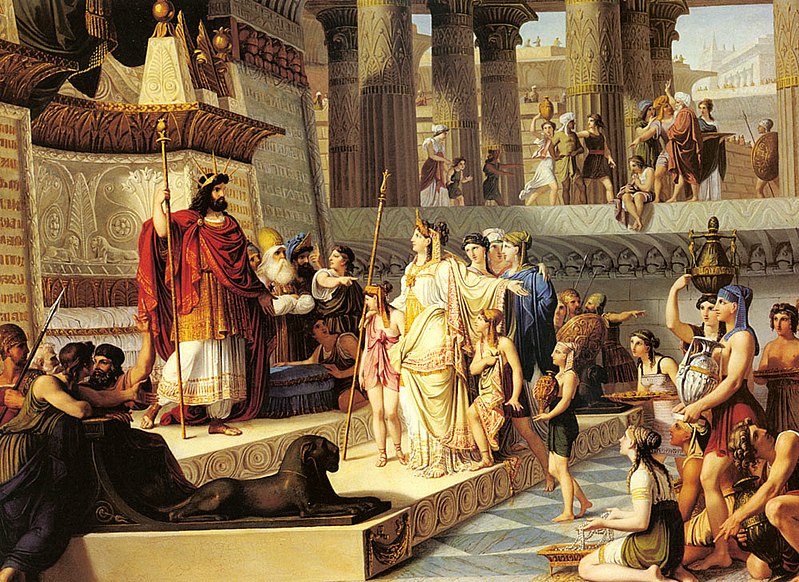
~ King Solomon, son of King David is commonly associated with wealth and wisdom. But if wealth and wisdom is the key to solve all problems, why did King Solomon’s kingdom fall after his death and why is it not possible for his descendants to continue to grow richer and more powerful?

The Idea Behind The Wealth of Nations

Empires rise and they inevitably fall. As I have argued in the third meditation, mankind has and will probably never achieve a state of Utopia on Earth. No government or political system has been able to outlive its usefulness. The system of the state would inevitably fail due to external or internal factors. We have taken a look at the external factors in the fifth meditation.

However, external factors which normally come in the form of military aggression is not without limitations and is therefore unsustainable in the long-run. War is an expensive business and the state’s coffers may not be replenished as fast as required. Among the internal factors that I have identified, the most important one of all is wealth.

In 1776, moral philosopher Adam Smith published his book called An Inquiry into the Nature and Causes of the Wealth of Nations. More commonly known as the Wealth of Nations, the book is often credited with the launching of free market capitalism and the Industrial Revolution, and over two centuries of unprecedented economic growth.

In his book, Adam Smith argued that free trade was the best way to prosperity. According to Smith, the adoption of free-trade policies would enrich and bind all of a nation’s citizens, and ultimately extend those benefits and ties to all the peoples of all nations of the world who practiced free-trade. The logic behind the success of free-trade according to Joseph Schumpeter was creative destruction.

Schumpeter argued that a market economy will incessantly revitalize itself from within by scrapping old and falling businesses and then reallocating resources to newer and more productive ones. This means that the market economy or an economy of which prices of goods and services are set by supply and demand would force an obsolete company to go out of business and forcefully reallocate resources of the fallen business to businesses that will have better use for them.

Alan Greenspan agrees with this line of thought and states that the failure of a centrally planned economy whereby prices and distribution of goods and services were set by central planners, lack the important ingredient of creative destruction. Furthermore, Greenspan points out that centrally planned economic systems have great difficulty in raising standards of living and creating wealth.

The reason for the failure of centrally planned economies was ultimately the lack of an effective market to coordinate producers’ supply and consumers’ demand. This imbalance and disequilibrium cause the economy to produce a large quantity of products that people do not want (a surplus) and a huge shortage of products the people do want but lack (a shortage). Consequently, the centrally planned economy fails as the economy fails to deliver the right products at the right quantities to the right people.

The Historical Evidence

In line with the thoughts of Smith, Schumpeter, and Greenspan, history has shown us that all the early civilizations had achieved incredible feats through creativity and innovation that brought forth a period of prosperity and economic growth. The ancient Mesopotamians gave the world the wheel, and the ancient Egyptians geometry and papyrus. More importantly, the early civilizations perfected the art of irrigation that enabled farmers to produce more food than they need.

The emergence of the agrarian economy did not solve all problems under the sun. Of the four (earliest) ancient civilizations, only the Chinese civilization continues to endure (China continues to use the same written language for the last 2,500 years). Yet even the Chinese civilization’s political system and form of government would change over the years and the ancient line of Chinese emperors broken many times in history.

The later civilizations like the ancient Greeks, Persians, and Romans would also follow a period of rapid expansion, decline, and eventual collapse. The eternal city of Rome may still exist today in Italy but the old inhabitants, the ancient Romans are long gone and normally forgotten. Almost every civilization fell not only because of pressure coming from external forces but because of an internally weakened economy.

In studying economics and looking back at history, we should ask ourselves an important question. If the ideas of Adam Smith and Joseph Schumpeter were correct, why did these civilizations fail to maintain their economic growth? A similar argument could be made against the Western renaissance, and the Industrial Revolution. Both periods brought a period of high economic growth that was in the end unsustainable.

GDP, Inflation, and Unemployment

In order to pursue this subject further, one must understand that in economics, one uses the country’s gross domestic product (GDP) to calculate economic growth. GDP is the total market value of all final goods and services produced annually within a country’s borders. GDP per capita to which a country’s GDP is divided by its total population is usually a measure of the standard of living.

Closely linked to GDP is inflation and unemployment. During periods of high economic growth, high rates of inflation (a continuous rise in price level) are a constant threat. High rates of inflation are undesirable as it erodes the purchasing power of money and causes a drop in real income (and standard of living). High rates of inflation are almost always present during times of high economic growth because the demand for resources like assets and labor is high.

On the other hand, periods of high economic growth normally comes with full employment and a rise in real wages (workers can demand higher pay). Following this logic, if high Real GDP growth leads to high inflation and low unemployment, this means that high inflation should generate low unemployment. While this is possible in the short-run, Milton Friedman attacked the assumption that low unemployment can be ‘bought’ with high inflation in the long-run.

In Friedman’s Noble Prize lecture in 1976, Milton Friedman proved that the Philips curve stable negative relation between the level of unemployment and inflation. In the long-run, the negative relationship between inflation and unemployment is unsustainable because workers in an attempt to maintain the purchasing power of their money demand higher wages (with no changes in the level of unemployment) and the stable relationship of the Philips curve collapse.

According to Frederic Mishkin (1997), price stability (a low and stable inflation rate) is the appropriate long-term goal for monetary policy as it promotes a more efficient economic system. Periods of hyperinflation experienced in Germany have given us ample data of the potential destruction should inflation be left unchecked.

The Limits of Economic Growth

High economic growth is not sustainable in the long-run. The Real GDP of an economy (GDP indexed to inflation) normally goes in a roller coaster trend which economist commonly refer to as the business cycle. In normal cases, the Real GDP goes from a peak into a period of contraction, a trough, and then enters a period of recovery before of expansion (to form another peak). This process repeats itself again and again throughout history.

Consider this simple explanation, when we start playing a game of monopoly, the board is empty and none of the players own any parcel of land on the board. As the game progresses, each player then buys different parcels of land. During this period (the first few turns), all players are able to make Pareto improvements to which in gaining a parcel of land causes no harm to the other players (relatively).

In the later parts of the game, the whole board with all its parcels of land will eventually be owned by a single player (you win by owning all the land and buildings on the board and driving everyone else into bankruptcy) and this is a position that is pareto efficient. At this point of the game, every parcel of land one player loses (this may be due to the lack of money) becomes another players gain and thus the players are engaged in a zero-sum game. The lack of resources in the game (there are only 12 hotels and 32 houses) also reflects economic reality.

However, the economy in reality is much more complex than a game of monopoly. In the game, the size of the board, the number of players and the availability of resources is subject to change. The five important causes of economic growth is the increase in natural resources, labor productivity, capital, technological advances, and property rights. All five may increase as a result of a discovery of a new oil field or a new technology that would yield more crops with the same amount of land.

During periods of high economic growth, the ownership of resources (means of production) would grow at a faster rate than the size of the economy (resources). This would lead to a form of market saturation and a zero-sum game with too many players fighting for too little resources. When an economy faces saturation of ownership, it must contract sooner or later.

Furthermore, during periods of high economic growth, the distribution of income is never equal. Some people who either by higher expertise, competence, and luck would inevitably be able to own more resources (assets) than people who are less able to manage their own finances or lack opportunities (extremely unlucky). Thus income inequality rises rapidly during times of rapid economic growth.

The other problem is demographics. One usually thinks of the aging population we face today as a challenge of the 21st century. This is incorrect as the exact same case of aging population happened during the last days of the Roman Empire (a contraction in economic growth). When the economy is booming, the number of children per family usually rises as there is more disposable income available (wages rise). The opposite is also true as families tend to have lesser children during times of economic crisis (less one mouth to feed).

This can be seen during the end of World War II whereby birthrates around the world was high. Children born between 1945 and 1964 are usually called the baby boomers (the economy was good). On the other hand, children born between 1965 and 1976 are usually called the baby bust (Generation X) as the number of children born each year was declining. This is followed by the baby boomlets (Generation Y) which are children born between 1977 and 1994 (the increase in birthrates was a result of the baby boomers having children.

From the demographic changes above, we can see that birthrates are variable and subject to the environment. This explains why the world economy faces periods of economic growth and also periods of economic contractions. When the world economy is growing, birthrates increase until a point where Pareto efficiency is gained and proceeds into a contraction phase. However, when the world economy is contracting, the children born when birthrates are high become adults and enter the economy.

Due to the fact that the world economy is generally contracting, most of these new adults would be unemployed or employed with the prospect of losing his/her jobs the next day (there are many substitutes). Idle citizens and citizens who live in fear of unemployment are not happy citizens. Furthermore, the periods of high economic growth may have caused a very high degree of income inequality, thus creating a major imbalance in the entire social structure.

The imbalances of income and underutilized workforce would result in the slow accumulation of social unrest triggered by perceived injustice. When the accumulated social unrest reaches a boiling point, it causes enough pressure to force reforms and sometimes a change in the political system governing a society. Hungry citizens as a golden rule almost never vote for the government.

Therefore, this explains why governments rush to secure economic resources either through trade or military means. The failure of a government to do so would mean its days are numbered. Bear in mind that what I am stating here is not a business cycle of 5 to 10 years but a supercycle. The period between the Great Depression to our current international economic crisis is an astounding span of 80 years!

There is however, one question that is left unanswered. If economic activities are carried out by individuals that are a part of the society, why do they make wrong choices? Is it not possible to make a civilization out of superior men who are intellectually and physically stronger than all other men? The next meditation would attempt to find out more on the individual and the freedom of choice.

~

_____________________________________________________________
The Limitations of Military Might

David and Goliath by Caravaggio

~ David and Goliath have since time immemorial been the representation of triumph over physical might and power. We look now at how this has happened and will happen again in reality. Bear in mind that the word civilization, state, and nation is referring to a society and an abstract representation.

The ultimate goal of a political system for a nation is to provide a reasonable amount of security for its citizens. Thomas Hobbes stresses that safety from harm is the chief justification of a government’s existence. Aristotle’s thoughts on the subject were also similar with Hobbes as he was known to say that the higher aim of politics is the protection of life itself.

In line with Aristotle and Hobbes, we can say that national security which is the protection against foreign (and sometimes domestic enemies) is the highest national priority. How then can a nation provide national security to its citizens? The answer to this question is to have armed forces (army) capable of either preemptively deterring or offensive attacking a threat to the nation.

The need of a standing army by a nation can be proven, because since the dawn of civilization, the need for a standing army has existed. But because the army of a nation exists and all nations have different agendas, conflict is inevitable. And by looking back into history yet again, we can see that warfare is a part of history as trees are a part of the forest.

In the fifth meditation, I will point out three examples of warfare in history. By doing so, I hope to justify what is the strongest motive for warfare. Consequently, I will also attempt to prove the limitations of warfare and in doing so form a stance that military power is not everything that matters.

~

Alexander the Great

Alexander the Great and the Greeks against the Persian Empire

Alexander the Great was the King of Macedonia and in a period of thirteen years would trample over all opposition and conquered half of the known world. Alexander became king in 336 BC (not yet age 20) after his father, Philip II was assassinated. Tutored by Aristotle who was at the time the greatest philosopher in the world, Alexander would proceed to use military force to dominate all opposition against his will.

The secret of the Macedonian military machine lies in the strength of the phalanx formation of well trained infantry, the flexibility of the ‘companion’ cavalry, and the leadership of Alexander the Great himself. The cutting of the Gordian Knot is a good example of Alexander’s character. Legend has it that he who manages to loose the knot would conquer all of Asia. Alexander wasted no time in doing so by cutting the knot with his sword.

Contrary to popular belief that Alexander started the invasion of the Persian Empire with a prosperous kingdom, Macedonia was in reality on the verge of bankruptcy. On the eve before the invasion, money was short in supply thus the maintenance of the army was a problem to be solved. Militarily, Alexander was also the underdog because the combined forces of the Macedonians and the Greek city states only numbered 35,000 troops. This is relatively a small contingent of soldiers compared to the gigantic armies the Persians were able to put to the field.

Numerical inferiority of his army could be overcome with better equipped, better trained, and better tactics than his foes. Economic problems however, were not that easily solved. So what does one do when one sees another person eating in luxury when one is hungry but strong? Alexander gave us the answer in 334 BC when he led his small army into Persia to conduct a wholesale robbery on the Persian Empire.

And rob he did, for the fortunes shine generously upon Alexander. Through superior tactics, bold strokes and an unwavering will, Alexander defeated the Persian armies in Granicus, Issus, and Gaugamela. After the destruction of the Persian Empire, Alexander turned next to India. There he defeated King Porus in 326BC. At this point, the army refuses to go further and Alexander was forced to return to Persia.

As he was making plans to launch an invasion on Arabia, the King of Conquerors mysteriously dies at age 33 leaving no legitimate heir to the empire he created. Subsequently after his death, Alexander’s Empire broke into three (Antigonid Greece, Ptolemaic Egypt, and Seleucid Syria).

The Empire of Alexander the Great

Chronology:

356 BC: Born in Pella, ancient capital of Macedonia

336 BC: Becomes King of Macedonia

334 BC: Leads Greek invasion of Persia

334 BC: Battle of Granicus

333 BC: Battle of Issus

331 BC: Battle of Gaugamela

327 BC: Invades India

324 BC: Returns to Persia

323 BC: Dies in Babylon

~

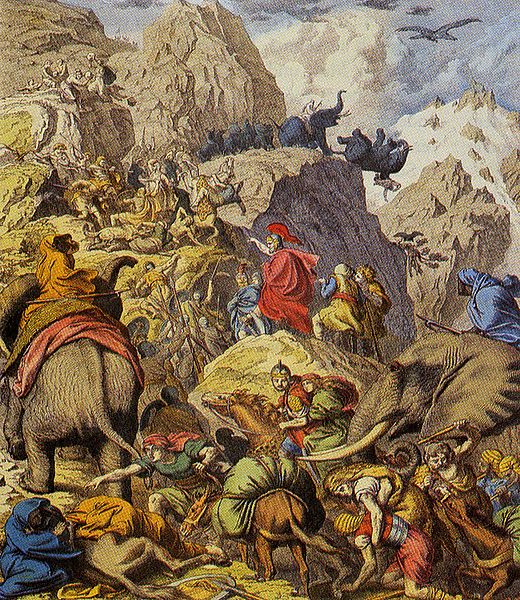
Hannibal Crossing the Alps

Hannibal of the Carthaginians against the Roman Empire

Hannibal was the son of Hamilcar Barca, a famous general that commanded the Carthaginian forces in Sicily during the first of the three Punic wars. After swearing an oath to be the enemy of Rome till the day he die, Hannibal was appointed commander in chief of the Carthaginians forces in 221 BC. Due to the overlapping spheres of influence between expansionist Rome and maritime Carthage, conflict was inevitable.

In 218 BC, Hannibal set out with an army of 35,000 men and 37 elephants to invade Rome and fulfill his oath. With an iron will, Hannibal would force march his army from Spain, across the Alps and into the Roman heartland. This Herculean feat was one of the greatest military outflanking movement in history because it bypass the sea power of Rome and brought Hannibal’s forces in direct contact with the Roman territories.

After successfully entering into enemy territory, Hannibal was to be master of Italy for many years. At the battle of Trebia, Lake Trasimeno, and Cannae (the Roman casualties numbered 70,000), Hannibal was to prove the world that he was the master of all types of warfare from ambush, intelligence, and the pincer movement. However, Hannibal proved not a master of siege warfare because try as he might, Hannibal never succeeded in capturing the heavily fortified city of Rome.

After Cannae, the Romans changed their tactics to guerrilla warfare by destroying everything eatable and disrupting Hannibal’s supply line. The Roman’s avoided direct confrontation with Hannibal and patiently amassed their strength and rebuild their army. In 204 BC, Scipio would lead a Roman invasion force and land in North Africa. In response, Hannibal was recalled from Italy to defend Carthage at all costs.

The two military commanders would clash in 202 BC at Zama, and Hannibal, betrayed by his mercenaries of Numidian Horsemen was finally defeated. Carthage was destroyed and Hannibal fled. In 183 BC, after fleeing from Syria to Asia Minor, Hannibal committed suicide by drinking poison.

Chronology:

247 BC: Hannibal in born in Carthage

221 BC: Hannibal appointed commander in chief

218 BC: Start of the Second Punic War

218 BC: Hannibal invades Italy

217 BC: Defeats Gaius Flaminias at Lake Trasimeno

216 BC: Inflicts the worst defeat on Roman Army at Cannae

203 BC: Hannibal is recalled to Carthage

202 BC: Hannibal defeated by Scipio at Zama

183 BC: Dies by taking poison

~

Diorama of the Siege of Leningrad

Adolf Hitler’s Nazi Germany against the Allies

Adolf Hitler would forever be known as one of the greatest sadists and pernicious individuals in history. Rising to the heights within the Nazi party, (by reducing unemployment and generating economic growth in the short-term) Hitler would ruthlessly crush all opposition to his power through government apparatus and misuse of power.

It is a common mistake to think that the cause of World War II was the different ideologies present during the 1930s. Although racial and cultural superiority (taken from Nordic Mythology and the writings of Friedrich Nietzsche) were the cornerstone of Hitler’s crusade against the rest of the world, economic data suggested otherwise.

By 1937, Germany was severely affected by the Great Depression (1929) and was on the brink of bankruptcy and collapse. Only by bullying neighboring countries and land grabbing did Hitler manage to keep the German economy afloat. In March 1938, Hitler forcibly annexed Austria and gained Austria’s underemployed workforce, and valuable foreign exchange.

After the Anschluss, Hitler turned next to Czechoslovakia and in September 1938 he completed the annexation of the Sudetenland (and later complete control of Czechoslovakia). By doing so, German military industry gained the famous Skoda Works which was at the time one of the most modern armament factories in the world.

Yet even after gaining Austria and Czechoslovakia, the German economy was in a hazardous situation that forced the Fuhrer to reduce allocations of steel (by 30%), copper (by 20%), Aluminum (by 47%), and Rubber (by 14%) to the Wehrmacht (the army). At this point (late fall of 1939), the tonnage and value of German exports and imports have already drop by three quarters and Hitler needed another scapegoat.

Fearing that the Soviet Union would interfere in his next land grab (Poland), Hitler shocked the world by signing the Nazi-Soviet anti-aggression pact in August 1939. The Soviets agreed on the partition of Poland and the Nazis gained important resources from Russia (grain, oil, ores (manganese and nickel), and rubber.

Just like how a lie may lead to theft and hence to murder, Germany had no choice but to keep using warfare to conduct a ‘wholesale robbery’ on other countries to keep her economy from collapsing. However, there is a limit to how military aggression can solve economic problems. By 1941, the Germans had defeated France and were at war with the Soviet Union (and later the United States of America.

Militarily, Germany started off on her bid for dominating Europe with the largest air force, an innovative tactic of warfare called Blitzkrieg (lightning war) and some of the best military commanders since the days of Alexander the Great and Hannibal. But even Field Marshalls like Erwin Rommel (the Desert Fox) and Eric von Manstein (the ‘backhand blow’) was unable to stop the tide forever.

Consequently, the Allies (the United States, the Soviet Union, and Great Britain) lost most of the battles fought in the short-run but won the war in the long-run. Knowing so, we can see that Hitler had made a serious miscalculation. German’s economic position was not prepared for a long war of attrition and the Allies eventually out-produced and out-equipped the German army. Hitler committed suicide.

Chronology

1938: Annexes Austria and then Czechoslovakia

1939: Germany attacks Poland

1940: Invasion of France and the Battle of Britain

1941: Invasion of the Soviet Union

1942: Italian government withdraws from the war

1943: Churchill, Roosevelt and Stalin meets at Teheran

1944: D-day, Allied forces land in France

1945: Hitler commits suicide, The War ends

_

National Income of the Powers in 1937 and Percentage Spent of Defense

Country

National Income (billions of dollars

Percentage on Defense

United States

68

1.5

British Empire

22

5.7

France

10

9.1

Germany

17

23.5

Italy

6

14.5

USSR

19

26.4

Japan

4

28.2

_

Country

Tank Production in 1944

Germany

17,800

Russia

29,000

Britain

5,000

United States

17,500 (29,500 in 1943)

_

Alliances

Population, mil

Territory, mil sq. km

Ha. Per head

GDP in 1990 prices, $ billion

Allies

1938: Allies Total

689.7

47.6

6.9

1024

1938: UK & France only

89.5

0.8

0.9

470

1942: Allies Total

783.5

68.0

8.7

1749

1942: UK, USA, & USSR only

345.0

29.3

8.5

1444

Axis

1938: Axis Total

258.9

6.3

2.4

751

1938: Germany, Italy, & Japan only

190.6

1.2

0.7

686

1942: Axis Total

634.6

11.2

1.8

1552

1942: Germany, Italy, & Japan only

190.6

1.2

0.7

686

_

Details

Allies

Axis

Combatant, million

106.4

76.9

Rifles and carbines, million

25.3

13.0

Combat aircraft, thousand

370

144

Machine guns, thousand

4827

1646

Guns, thousand

1357

462

Armored vehicles, thousand

216

51

Mortar’s thousand

516

100

Major naval vessels

8999

1734

Machine pistols, thousand

11604

1185

Ballistic missiles

0

6000

Atomic Weapons

4

0

_

A Critique

In the short-term, military power may seem overwhelmingly important as a decisive means to end conflict of interests between two countries. In the first and the third example, both Alexander the Great and Hitler used military aggression as a way to solve internal economic problems. Indeed, there was evidence showing that the Nazis systematically searched the dead for gold tooth filings and wedding rings while the bodies of many victims were used to manufacture soap!

The second example illustrates how Carthage and Rome fought over the control of the Mediterranean. While the story was slightly different than the other two examples, they were actually fundamentally the same. While Alexander and Hitler fought to solve an existing economic problem, Hannibal was fighting to solve an economic problem destined to happen in the future!

If one would look at the map of Europe, one would realize that the ruins of Carthage in Tunisia lie almost directly opposite of Rome in Italy. This justifies the reason why Carthage was concerned when infant Rome was growing too rich too fast. Left unchecked, Rome would eventually harm the economy of Carthage by threatening to break its monopoly of trade in the region.

When we compare the three examples side by side, we realized that economic reasons were normally the underlying cause in spurring military conflicts. Although personal ideology or prestige have played a role in causing military action, bear in mind that a leader is only a leader through a certain level of acceptance by the people. Therefore, in analyzing military history, we should pose ourselves an important question. Did the hero create his environment or did the environment create the hero?

The answer to the question above is of course subject to the situation and personal bias. However, one thing is for certain and that is economic reasons were usually the motive for military actions. In conclusion, the real weakness of power lies in the economic conditions of a nation. Why then do economic conditions change from time to time? Why has civilization failed time and time again to sustain its favorable economic condition? One thing is for certain, the rise and fall of civilizations are closely linked to the economic and military limitations.

“The decline of Rome was the natural and inevitable effect of immoderate greatness. Prosperity ripened the principle of decay; the cause of the destruction multiplied with the extent of conquest; and, as soon as time or accident had removed the artificial supports, the stupendous fabric yielded to the pressure of its own weight. The story of the ruin is simple and obvious; and instead of inquiring why the Roman Empire was destroyed, we should rather be surprised that it has subsisted for so long.”

~ Edward Gibbons

“A great civilization is not conquered from without until it has destroyed itself from within.”

~ Will Durant

~

_____________________________________________________________