
David and Goliath by Caravaggio
The ultimate goal of a political system for a nation is to provide a reasonable amount of security for its citizens. Thomas Hobbes stresses that safety from harm is the chief justification of a government’s existence. Aristotle’s thoughts on the subject were also similar with Hobbes as he was known to say that the higher aim of politics is the protection of life itself.
In line with Aristotle and Hobbes, we can say that national security which is the protection against foreign (and sometimes domestic enemies) is the highest national priority. How then can a nation provide national security to its citizens? The answer to this question is to have armed forces (army) capable of either preemptively deterring or offensive attacking a threat to the nation.
The need of a standing army by a nation can be proven, because since the dawn of civilization, the need for a standing army has existed. But because the army of a nation exists and all nations have different agendas, conflict is inevitable. And by looking back into history yet again, we can see that warfare is a part of history as trees are a part of the forest.
In the fifth meditation, I will point out three examples of warfare in history. By doing so, I hope to justify what is the strongest motive for warfare. Consequently, I will also attempt to prove the limitations of warfare and in doing so form a stance that military power is not everything that matters.
~

Alexander the Great
Alexander the Great and the Greeks against the Persian Empire
Alexander the Great was the King of Macedonia and in a period of thirteen years would trample over all opposition and conquered half of the known world. Alexander became king in 336 BC (not yet age 20) after his father, Philip II was assassinated. Tutored by Aristotle who was at the time the greatest philosopher in the world, Alexander would proceed to use military force to dominate all opposition against his will.
The secret of the Macedonian military machine lies in the strength of the phalanx formation of well trained infantry, the flexibility of the ‘companion’ cavalry, and the leadership of Alexander the Great himself. The cutting of the Gordian Knot is a good example of Alexander’s character. Legend has it that he who manages to loose the knot would conquer all of Asia. Alexander wasted no time in doing so by cutting the knot with his sword.
Contrary to popular belief that Alexander started the invasion of the Persian Empire with a prosperous kingdom, Macedonia was in reality on the verge of bankruptcy. On the eve before the invasion, money was short in supply thus the maintenance of the army was a problem to be solved. Militarily, Alexander was also the underdog because the combined forces of the Macedonians and the Greek city states only numbered 35,000 troops. This is relatively a small contingent of soldiers compared to the gigantic armies the Persians were able to put to the field.
Numerical inferiority of his army could be overcome with better equipped, better trained, and better tactics than his foes. Economic problems however, were not that easily solved. So what does one do when one sees another person eating in luxury when one is hungry but strong? Alexander gave us the answer in 334 BC when he led his small army into Persia to conduct a wholesale robbery on the Persian Empire.
And rob he did, for the fortunes shine generously upon Alexander. Through superior tactics, bold strokes and an unwavering will, Alexander defeated the Persian armies in Granicus, Issus, and Gaugamela. After the destruction of the Persian Empire, Alexander turned next to India. There he defeated King Porus in 326BC. At this point, the army refuses to go further and Alexander was forced to return to Persia.
As he was making plans to launch an invasion on Arabia, the King of Conquerors mysteriously dies at age 33 leaving no legitimate heir to the empire he created. Subsequently after his death, Alexander’s Empire broke into three (Antigonid Greece, Ptolemaic Egypt, and Seleucid Syria).

The Empire of Alexander the Great
Chronology:
356 BC: Born in Pella, ancient capital of Macedonia
336 BC: Becomes King of Macedonia
334 BC: Leads Greek invasion of Persia
334 BC: Battle of Granicus
333 BC: Battle of Issus
331 BC: Battle of Gaugamela
327 BC: Invades India
324 BC: Returns to Persia
323 BC: Dies in Babylon
~
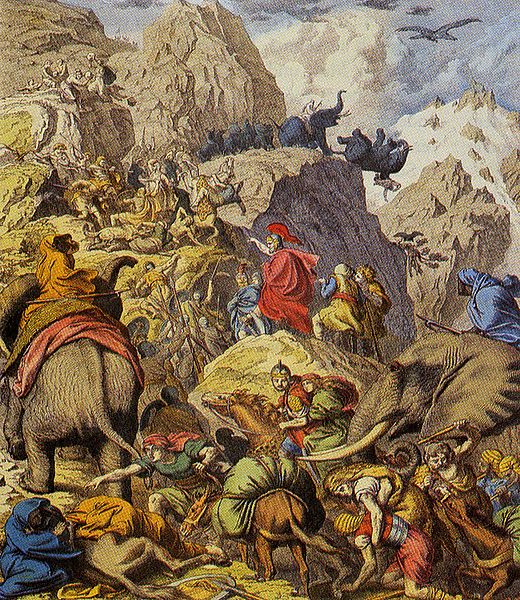
Hannibal Crossing the Alps
Hannibal of the Carthaginians against the Roman Empire
Hannibal was the son of Hamilcar Barca, a famous general that commanded the Carthaginian forces in Sicily during the first of the three Punic wars. After swearing an oath to be the enemy of Rome till the day he die, Hannibal was appointed commander in chief of the Carthaginians forces in 221 BC. Due to the overlapping spheres of influence between expansionist Rome and maritime Carthage, conflict was inevitable.
In 218 BC, Hannibal set out with an army of 35,000 men and 37 elephants to invade Rome and fulfill his oath. With an iron will, Hannibal would force march his army from Spain, across the Alps and into the Roman heartland. This Herculean feat was one of the greatest military outflanking movement in history because it bypass the sea power of Rome and brought Hannibal’s forces in direct contact with the Roman territories.
After successfully entering into enemy territory, Hannibal was to be master of Italy for many years. At the battle of Trebia, Lake Trasimeno, and Cannae (the Roman casualties numbered 70,000), Hannibal was to prove the world that he was the master of all types of warfare from ambush, intelligence, and the pincer movement. However, Hannibal proved not a master of siege warfare because try as he might, Hannibal never succeeded in capturing the heavily fortified city of Rome.
After Cannae, the Romans changed their tactics to guerrilla warfare by destroying everything eatable and disrupting Hannibal’s supply line. The Roman’s avoided direct confrontation with Hannibal and patiently amassed their strength and rebuild their army. In 204 BC, Scipio would lead a Roman invasion force and land in North Africa. In response, Hannibal was recalled from Italy to defend Carthage at all costs.
The two military commanders would clash in 202 BC at Zama, and Hannibal, betrayed by his mercenaries of Numidian Horsemen was finally defeated. Carthage was destroyed and Hannibal fled. In 183 BC, after fleeing from Syria to Asia Minor, Hannibal committed suicide by drinking poison.
Chronology:
247 BC: Hannibal in born in Carthage
221 BC: Hannibal appointed commander in chief
218 BC: Start of the Second Punic War
218 BC: Hannibal invades Italy
217 BC: Defeats Gaius Flaminias at Lake Trasimeno
216 BC: Inflicts the worst defeat on Roman Army at Cannae
203 BC: Hannibal is recalled to Carthage
202 BC: Hannibal defeated by Scipio at Zama
183 BC: Dies by taking poison
~

Diorama of the Siege of Leningrad
Adolf Hitler’s Nazi Germany against the Allies
Adolf Hitler would forever be known as one of the greatest sadists and pernicious individuals in history. Rising to the heights within the Nazi party, (by reducing unemployment and generating economic growth in the short-term) Hitler would ruthlessly crush all opposition to his power through government apparatus and misuse of power.
It is a common mistake to think that the cause of World War II was the different ideologies present during the 1930s. Although racial and cultural superiority (taken from Nordic Mythology and the writings of Friedrich Nietzsche) were the cornerstone of Hitler’s crusade against the rest of the world, economic data suggested otherwise.
By 1937, Germany was severely affected by the Great Depression (1929) and was on the brink of bankruptcy and collapse. Only by bullying neighboring countries and land grabbing did Hitler manage to keep the German economy afloat. In March 1938, Hitler forcibly annexed Austria and gained Austria’s underemployed workforce, and valuable foreign exchange.
After the Anschluss, Hitler turned next to Czechoslovakia and in September 1938 he completed the annexation of the Sudetenland (and later complete control of Czechoslovakia). By doing so, German military industry gained the famous Skoda Works which was at the time one of the most modern armament factories in the world.
Yet even after gaining Austria and Czechoslovakia, the German economy was in a hazardous situation that forced the Fuhrer to reduce allocations of steel (by 30%), copper (by 20%), Aluminum (by 47%), and Rubber (by 14%) to the Wehrmacht (the army). At this point (late fall of 1939), the tonnage and value of German exports and imports have already drop by three quarters and Hitler needed another scapegoat.
Fearing that the Soviet Union would interfere in his next land grab (Poland), Hitler shocked the world by signing the Nazi-Soviet anti-aggression pact in August 1939. The Soviets agreed on the partition of Poland and the Nazis gained important resources from Russia (grain, oil, ores (manganese and nickel), and rubber.
Just like how a lie may lead to theft and hence to murder, Germany had no choice but to keep using warfare to conduct a ‘wholesale robbery’ on other countries to keep her economy from collapsing. However, there is a limit to how military aggression can solve economic problems. By 1941, the Germans had defeated France and were at war with the Soviet Union (and later the United States of America.
Militarily, Germany started off on her bid for dominating Europe with the largest air force, an innovative tactic of warfare called Blitzkrieg (lightning war) and some of the best military commanders since the days of Alexander the Great and Hannibal. But even Field Marshalls like Erwin Rommel (the Desert Fox) and Eric von Manstein (the ‘backhand blow’) was unable to stop the tide forever.
Consequently, the Allies (the United States, the Soviet Union, and Great Britain) lost most of the battles fought in the short-run but won the war in the long-run. Knowing so, we can see that Hitler had made a serious miscalculation. German’s economic position was not prepared for a long war of attrition and the Allies eventually out-produced and out-equipped the German army. Hitler committed suicide.
Chronology
1938: Annexes Austria and then Czechoslovakia
1939: Germany attacks Poland
1940: Invasion of France and the Battle of Britain
1941: Invasion of the Soviet Union
1942: Italian government withdraws from the war
1943: Churchill, Roosevelt and Stalin meets at Teheran
1944: D-day, Allied forces land in France
1945: Hitler commits suicide, The War ends
_
| National Income of the Powers in 1937 and Percentage Spent of Defense | ||
| Country | National Income (billions of dollars | Percentage on Defense |
| United States | 68 | 1.5 |
| British Empire | 22 | 5.7 |
| France | 10 | 9.1 |
| Germany | 17 | 23.5 |
| Italy | 6 | 14.5 |
| USSR | 19 | 26.4 |
| Japan | 4 | 28.2 |
_
| Country | Tank Production in 1944 |
| Germany | 17,800 |
| Russia | 29,000 |
| Britain | 5,000 |
| United States | 17,500 (29,500 in 1943) |
_
| Alliances | Population, mil | Territory, mil sq. km | Ha. Per head | GDP in 1990 prices, $ billion |
| Allies 1938: Allies Total | 689.7 | 47.6 | 6.9 | 1024 |
| 1938: UK & France only | 89.5 | 0.8 | 0.9 | 470 |
| 1942: Allies Total | 783.5 | 68.0 | 8.7 | 1749 |
| 1942: UK, USA, & USSR only | 345.0 | 29.3 | 8.5 | 1444 |
| Axis 1938: Axis Total | 258.9 | 6.3 | 2.4 | 751 |
| 1938: Germany, Italy, & Japan only | 190.6 | 1.2 | 0.7 | 686 |
| 1942: Axis Total | 634.6 | 11.2 | 1.8 | 1552 |
| 1942: Germany, Italy, & Japan only | 190.6 | 1.2 | 0.7 | 686 |
_
| Details | Allies | Axis |
| Combatant, million | 106.4 | 76.9 |
| Rifles and carbines, million | 25.3 | 13.0 |
| Combat aircraft, thousand | 370 | 144 |
| Machine guns, thousand | 4827 | 1646 |
| Guns, thousand | 1357 | 462 |
| Armored vehicles, thousand | 216 | 51 |
| Mortar’s thousand | 516 | 100 |
| Major naval vessels | 8999 | 1734 |
| Machine pistols, thousand | 11604 | 1185 |
| Ballistic missiles | 0 | 6000 |
| Atomic Weapons | 4 | 0 |
_
A Critique
In the short-term, military power may seem overwhelmingly important as a decisive means to end conflict of interests between two countries. In the first and the third example, both Alexander the Great and Hitler used military aggression as a way to solve internal economic problems. Indeed, there was evidence showing that the Nazis systematically searched the dead for gold tooth filings and wedding rings while the bodies of many victims were used to manufacture soap!
The second example illustrates how Carthage and Rome fought over the control of the Mediterranean. While the story was slightly different than the other two examples, they were actually fundamentally the same. While Alexander and Hitler fought to solve an existing economic problem, Hannibal was fighting to solve an economic problem destined to happen in the future!
If one would look at the map of Europe, one would realize that the ruins of Carthage in Tunisia lie almost directly opposite of Rome in Italy. This justifies the reason why Carthage was concerned when infant Rome was growing too rich too fast. Left unchecked, Rome would eventually harm the economy of Carthage by threatening to break its monopoly of trade in the region.
When we compare the three examples side by side, we realized that economic reasons were normally the underlying cause in spurring military conflicts. Although personal ideology or prestige have played a role in causing military action, bear in mind that a leader is only a leader through a certain level of acceptance by the people. Therefore, in analyzing military history, we should pose ourselves an important question. Did the hero create his environment or did the environment create the hero?
The answer to the question above is of course subject to the situation and personal bias. However, one thing is for certain and that is economic reasons were usually the motive for military actions. In conclusion, the real weakness of power lies in the economic conditions of a nation. Why then do economic conditions change from time to time? Why has civilization failed time and time again to sustain its favorable economic condition? One thing is for certain, the rise and fall of civilizations are closely linked to the economic and military limitations.
“The decline of Rome was the natural and inevitable effect of immoderate greatness. Prosperity ripened the principle of decay; the cause of the destruction multiplied with the extent of conquest; and, as soon as time or accident had removed the artificial supports, the stupendous fabric yielded to the pressure of its own weight. The story of the ruin is simple and obvious; and instead of inquiring why the Roman Empire was destroyed, we should rather be surprised that it has subsisted for so long.”
~ Edward Gibbons
“A great civilization is not conquered from without until it has destroyed itself from within.”
~ Will Durant
~
_____________________________________________________________


No comments:
Post a Comment